How each line is worked out
The defaults are an example: an 85 g PLA print that runs for 4.5 hours. Replace them with your own numbers. Your input is saved in this browser, so it is still there next time.
Filament
grams used × spool price ÷ spool weight in grams
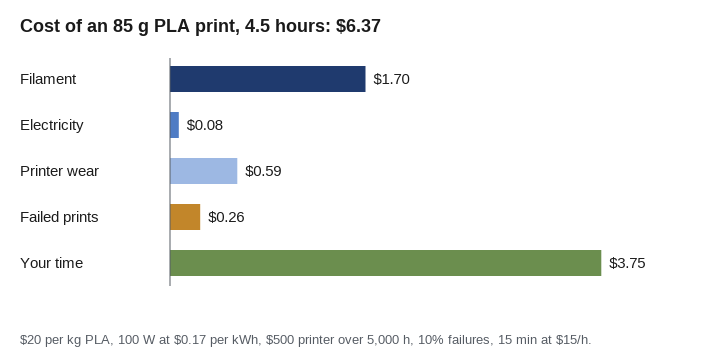
A 1 kg spool that cost $20 works out at 2 cents a gram, so 85 g is $1.70. If your slicer shows meters instead of grams, change the unit next to the amount and the calculator converts it using the material's density. For multi-colour prints, add a line for each filament.
Resin
ml used × bottle price ÷ bottle size in ml
Most resin is sold by weight while slicers report millilitres. If you enter the bottle size in grams, the calculator converts it at 1.1 g per ml, a typical density for standard resin.
Electricity
watts ÷ 1000 × hours × price per kWh
The print time box takes most slicer formats: 4h 30m, 4:30, 270 min or 1d 2h. A plain number counts as hours. At 100 W, a 4.5 hour print uses 0.45 kWh, which is about 8 cents at $0.17 per kWh. The electricity page explains how to measure your printer's real power draw.
Printer wear
(printer price ÷ expected life in hours + parts per hour) × print hours
A $500 printer that you expect to run for 5,000 hours costs 10 cents per printing hour. Parts and repairs cover the things that wear out: nozzles, belts, PEI sheets, and on resin printers the FEP film and the LCD screen.
Failed prints
(filament + electricity + wear) × rate ÷ (1 − rate)
If 1 print in 10 fails, the other 9 have to pay for it. That adds 1/9 of the cost, about 11%. The calculator assumes a failed print runs to the end. Most fail partway, so the real figure is a little lower.
Your time
(setup minutes + finishing minutes × items) ÷ 60 × hourly rate
Setup happens once per plate. Finishing happens for every item. This is why printing ten small items on one plate costs less per item than ten separate prints. For prints you sell, this is usually the largest line.
Selling price
cost per item × (1 + markup) ÷ (1 − platform fee)
Dividing by (1 − fee) makes the fee come out of the price and leaves your markup whole. Adding the fee percentage on top falls a little short. The pricing guide has a worked example.
Questions
How much does it cost to 3D print something?
For a small PLA part, material, power and printer wear often come to a few dollars. The default example on this page, an 85 g PLA print that runs for 4.5 hours, costs $2.62 once you add a 10% allowance for failed prints. If you are selling, your time is usually the biggest line: 15 minutes at $15 an hour adds $3.75.
How do I calculate the filament cost of a print?
Multiply the grams the slicer reports by the spool price, then divide by the spool weight in grams. A 1 kg spool that cost $20 works out at 2 cents a gram, so an 85 g print uses $1.70 of filament. The filament cost page has a per-gram table and a meters-to-grams converter.
Is this 3D print cost calculator free?
Yes. There is no sign-up and no limit. The maths runs in your browser and nothing you type is sent to a server.
Does it work for resin printers?
Yes. Pick Resin at the top and enter the bottle price, the bottle size in ml or grams, and the ml of resin your slicer reports. Add wash and cure supplies such as IPA and gloves under extras.
Where do I find the print time and filament weight?
Slice the model and open the slicer's preview or summary. Cura, PrusaSlicer, OrcaSlicer and Bambu Studio all show the estimated print time and the filament used in grams or meters. Copy the time as it appears, for example 4h 30m, into the print time box.
How much electricity does a 3D printer use?
Much less than the power supply rating. Most of the power goes into heating the bed and nozzle, and once they reach temperature the heaters switch on and off. A plug-in power meter gives the real figure for your printer: divide the kWh it shows by the hours the print took. More on the electricity page.
Why does the failed prints line add more than the failure rate?
If 1 print in 10 fails, every 9 good prints have to pay for 1 failed one. That is 1/9 of the material, power and wear, or about 11%, not 10%. The calculator assumes a failed print runs to the end, so it errs on the high side.