How to price 3D prints
A price that works covers four things: what the print costs to make, your time, a profit, and the fees taken by wherever you sell. Work them out in that order.
price = cost per item × (1 + markup) ÷ (1 − platform fee)
Here "cost per item" already includes your time at an hourly rate. Markup is the profit on top.
1. Work out the cost to make
Add up filament or resin, electricity, printer wear and an allowance for failed prints. The 3D print cost calculator gives each of these its own line. Material is the line people remember. Printer wear and failed prints are the ones they forget.
2. Pay yourself an hourly rate
Count the minutes you actually spend: slicing, starting the print, clearing the bed, removing supports, sanding, packing. Put your time into the cost at an hourly rate, separate from the markup. If you skip this, the markup ends up paying for your time and there is no profit left.
Split your time into two kinds:
- Setup happens once per plate, however many items are on it.
- Finishing happens for every item.
Setup is why one-off prints are expensive and batches are cheap.
3. Add a markup
The markup is your profit. It pays for the prints you design but never sell, slow months and new equipment. There is no standard figure. Look at what similar items sell for, then check whether your price leaves a profit you are happy with.
Markup and margin are easy to mix up. Markup is profit divided by cost. Margin is profit divided by price.
| Markup | Margin | Price of a $10 cost |
|---|---|---|
| 25% | 20% | $12.50 |
| 50% | 33% | $15.00 |
| 100% | 50% | $20.00 |
| 150% | 60% | $25.00 |
| 200% | 67% | $30.00 |
4. Allow for platform fees
Marketplaces and card processors take a percentage of the sale price. Divide by (1 − fee) to cover it. To keep $10 after a 10% fee, charge $10 ÷ 0.9 = $11.11. Adding 10% on top gives $11, and 10% of $11 leaves you $9.90.
Flat fees per listing or per order don't fit a percentage. Add them to the extras per item instead.
Worked example: a plate of eight keychains
Eight keychains printed together in PLA. The slicer says 48 g and 3 hours. Each one gets a metal keyring that costs $0.35. The other numbers are the calculator's defaults.
| Line | Working | Plate of 8 |
|---|---|---|
| Filament | 48 g × $20 ÷ 1,000 g | $0.96 |
| Electricity | 100 W for 3 h at $0.17 per kWh | $0.05 |
| Printer wear | 3 h × ($500 ÷ 5,000 h + $0.03) | $0.39 |
| Failed prints | 10% rate, so 1/9 of the three lines above | $0.16 |
| Your time | 10 min setup + 2 min × 8 finishing = 26 min at $15/h | $6.50 |
| Extras | 8 keyrings × $0.35 | $2.80 |
| Total for the plate | $10.86 | |
| Cost per keychain | $1.36 | |
With a 100% markup and a 10% platform fee, the price is $1.36 × 2 ÷ 0.9 = $3.02. The fee takes $0.30, which leaves $2.71. Take away the $1.36 cost and $1.36 is profit, on top of the $15 an hour already paid for your time.
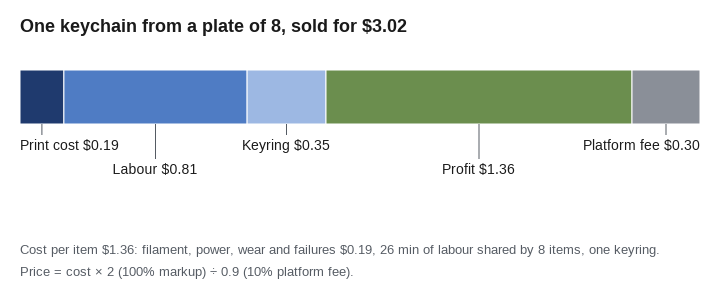
Print the same keychain on its own and the numbers change. The 10 minutes of setup now falls on a single item, and the cost rises to $3.61 before markup. That is the case for batching, and for charging extra on one-off orders.
When the market price is lower than your cost
If similar items sell for less than it costs you to make them, you have a few options:
- Fit more items on a plate so setup is shared.
- Change the design so it needs no supports and less finishing.
- Print with a larger nozzle or thicker layers where the finish allows.
- Drop the item and sell the ones that pay.
Things the formula leaves out
- Design or modelling time for custom work. Quote it separately, as a flat fee or by the hour.
- Shipping and packaging, unless you add them to extras per item.
- Sales tax or VAT. Rules depend on where you and your buyer are.
- Licences. Many models on download sites don't allow selling prints, so check before you list one.
Questions
How much should I charge for 3D printing?
Start from the cost to make one item, including your time at an hourly rate. Add a markup for profit, then divide by (1 minus the platform fee) so the fee comes out of the price. Compare the result with what similar items sell for.
What is the difference between markup and margin?
Markup is profit as a percentage of cost. Margin is profit as a percentage of the price. A $10 item that cost $5 has a 100% markup and a 50% margin.
How do I add a platform fee to my price?
Divide by (1 minus the fee). To keep $10 after a 10% fee, charge $10 / 0.9 = $11.11. Adding 10% gives $11, and the fee on $11 leaves you $9.90.