The formula
cost = watts ÷ 1000 × hours × price per kWh
Watts divided by 1,000 gives kilowatts. Kilowatts times hours gives kilowatt-hours (kWh), the unit on your bill. A printer averaging 100 W for 10 hours uses 1 kWh.
Cost of a 10 hour print
Find your printer's average power on the left and your electricity price along the top. Divide by 10 for the cost per hour.
| Average power | 0.10 per kWh | 0.15 | 0.20 | 0.30 | 0.40 |
|---|---|---|---|---|---|
| 50 W | 0.05 | 0.08 | 0.10 | 0.15 | 0.20 |
| 100 W | 0.10 | 0.15 | 0.20 | 0.30 | 0.40 |
| 150 W | 0.15 | 0.23 | 0.30 | 0.45 | 0.60 |
| 200 W | 0.20 | 0.30 | 0.40 | 0.60 | 0.80 |
| 300 W | 0.30 | 0.45 | 0.60 | 0.90 | 1.20 |
Amounts are in the same currency as your electricity price.
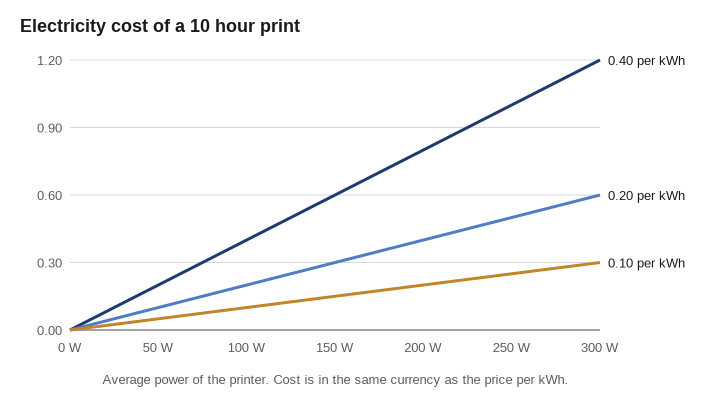
Why the power supply rating is the wrong number
The label on the power supply, often 350 W or more, is the most it can deliver. A printer only gets near that while the bed and nozzle heat up at the start. Once they reach temperature, the heaters switch on and off to hold it, and the average falls well below the rating. Use the rating and you overstate the cost several times over.
What uses the power
- The heated bed uses the most. A bed at 100 °C for ABS draws more than one at 60 °C for PLA, and a large bed more than a small one.
- The hotend comes next. It is small but runs hotter.
- Motors, fans, the board and the screen add a little on top.
- A cold or draughty room makes the heaters work harder. An enclosure helps keep the heat in.
Resin printers have no heated bed and no hotend. Their power goes into the UV light, the screen and the motor, so they usually draw less than a filament printer.
How to measure your printer
- Plug a power meter between the wall socket and the printer. Plug-in energy meters and smart plugs with energy monitoring both work.
- Reset the meter's kWh counter and run a normal, complete print.
- Divide the kWh shown by the hours the print took, then multiply by 1,000. That is your average power in watts.
Measure once for each material you print often, since bed temperature changes the result. Enter the figure in the 3D print cost calculator and every quote after that uses it.
Finding your price per kWh
Your bill lists a price per kWh, sometimes in several tiers. For one figure that includes fixed charges and taxes, divide the total of the bill by the kWh you used that month.
Questions
How much does it cost to run a 3D printer for 24 hours?
At an average of 100 W, 24 hours uses 2.4 kWh. At $0.17 per kWh that is about $0.41. Multiply by your own power draw and electricity price.
How much does it cost to run a 3D printer per month?
Printing 4 hours a day at 100 W uses about 12 kWh a month, which is about $2.04 at $0.17 per kWh. Put your own hours per week into the calculator above.
Does a 3D printer use a lot of electricity?
Not compared with its power supply rating. The heaters run hard while the bed and nozzle warm up, then switch on and off to hold the temperature. For most prints, electricity is a small share of the cost next to filament.